
Healthcare & Wellness / Dental & Orthodontic Practices
Dental marketing built around the new-patient offer
Dental marketing from MBI is one program of new-mover and neighborhood direct mail, Facebook offer campaigns, consented SMS recall and practice print, planned and run by one team.
Not sure where to start? Talk with our teamDental marketing
Who is the dental mailing addressed to, and what does it offer?
The short answer
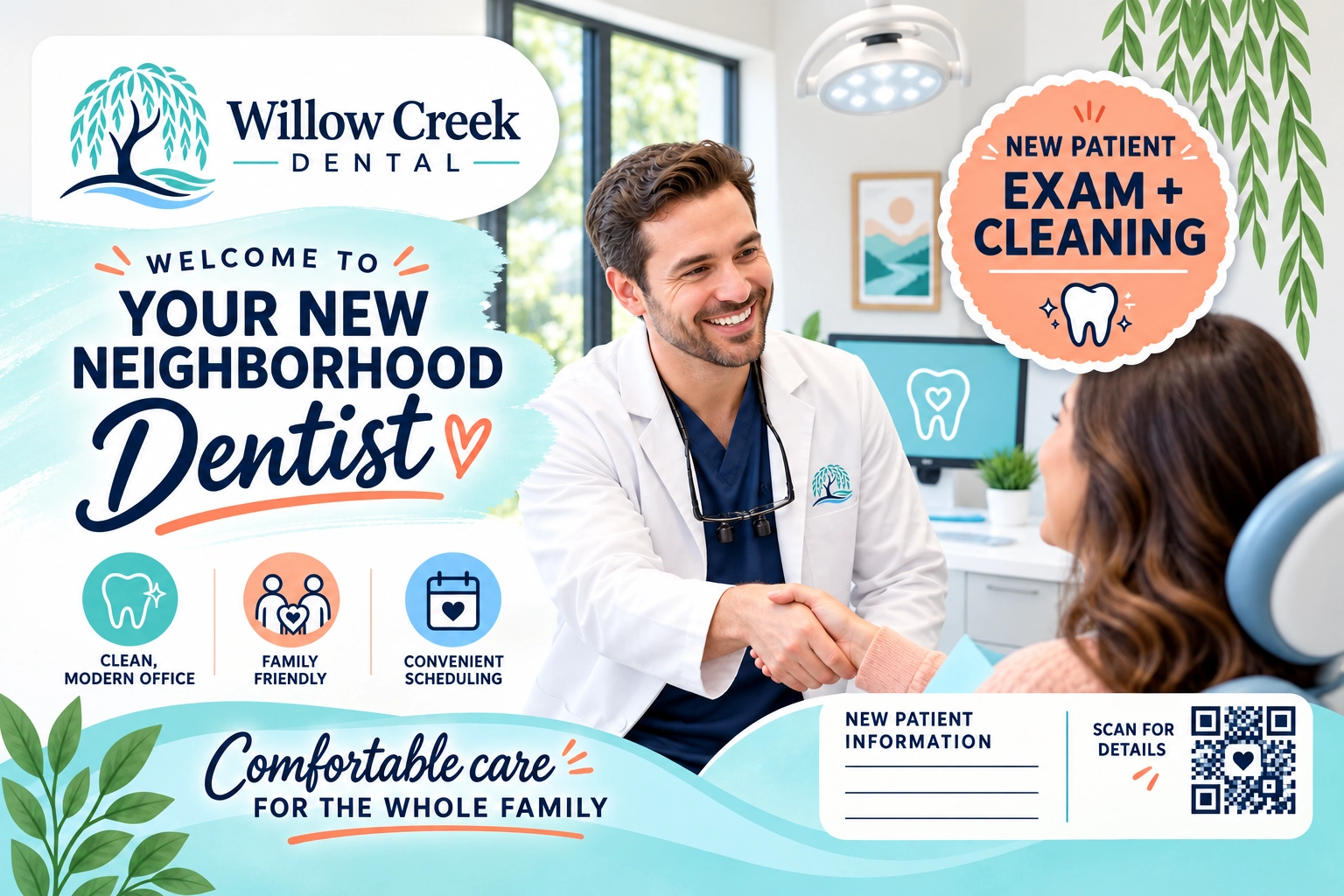
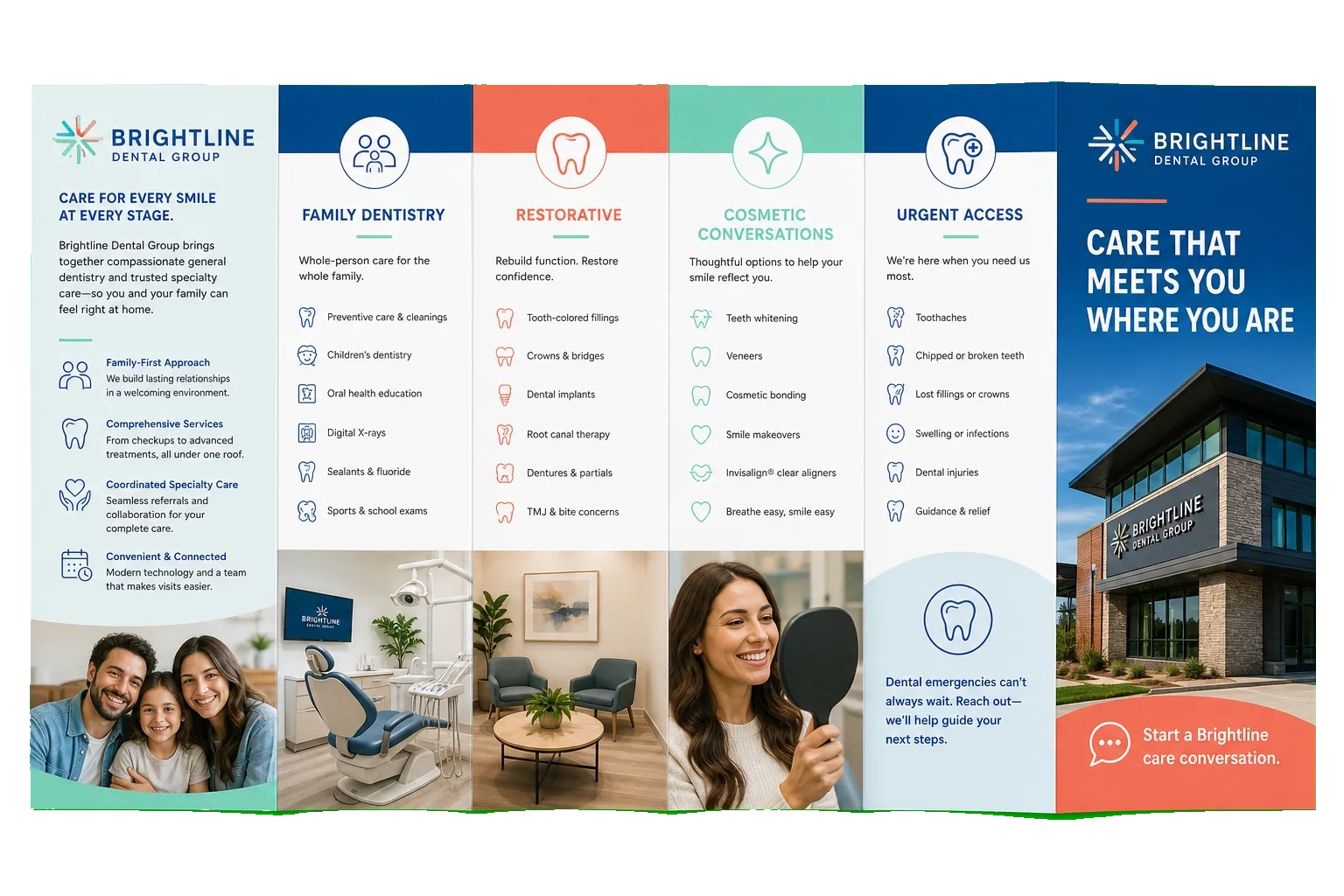
Dental direct mail commonly goes to new residents and nearby households, and it carries a clear new-patient offer — an exam or a cleaning — with a direct booking call to action. Postcards and brochures are the pieces used for it. MBI selects the addresses, designs and prints the piece, and mails it in house.
The documented mail. Dental direct mail commonly targets new residents and nearby households with clear new-patient offers and a direct booking CTA; postcards and brochures are used for this purpose.
USPS Domestic Mail Manual 201.1.2.1 provides that each stamped card or postcard, or each half of a double stamped card or postcard, claimed at a card price must be not less than 3-1/2 inches high, 5 inches long, and 0.007 inch thick; not more than 4-1/4 inches high, 6 inches long, or 0.016 inch thick for each stamped card or each half of a double-stamped card or double postcard; not more than 6 inches high, 9 inches long, or 0.016 inch thick for each postcard; at least 0.009 inch thick where the card is more than 4-1/4 inches high or 6 inches long; rectangular with four square corners and parallel opposite sides; and within an aspect ratio, length divided by height, of 1.3 to 2.5 inclusive.
USPS Domestic Mail Manual 201.1.2.1
postcard mailing services targeted direct mail direct mail marketing services
Postcard · Direct Mail
Brochure · Printing
The card-price sizes
New patients
Where does dental new patient marketing actually start?
The short answer
Dental new patient marketing starts with capacity and an address selection. This program is built for dental groups and DSOs with multiple providers, defined new-patient capacity, high-value service lines and reliable call-center conversion, and the first campaign is a new-mover or neighborhood drop carrying a new-patient exam or cleaning offer.
Built for. This program is built for dental groups and DSOs with multiple providers, defined new-patient capacity, high-value service lines and reliable call-center conversion.
Geography, never health. Every mail audience this vertical's research names is geographic — new residents and nearby households — and no researched sentence supports selecting a household by anything about a person's health.
45 CFR 164.508(a)(3) provides that a covered entity must obtain an authorization for any use or disclosure of protected health information for marketing, except if the communication is in the form of a face-to-face communication made by a covered entity to an individual, or a promotional gift of nominal value provided by the covered entity; and that if the marketing involves financial remuneration to the covered entity from a third party, the authorization must state that such remuneration is involved.
HIPAA Privacy Rule, 45 CFR 164.508(a)(3)
The open chair
The open chair
Facebook and Instagram
Which single offer do dental Facebook ads carry?
The short answer
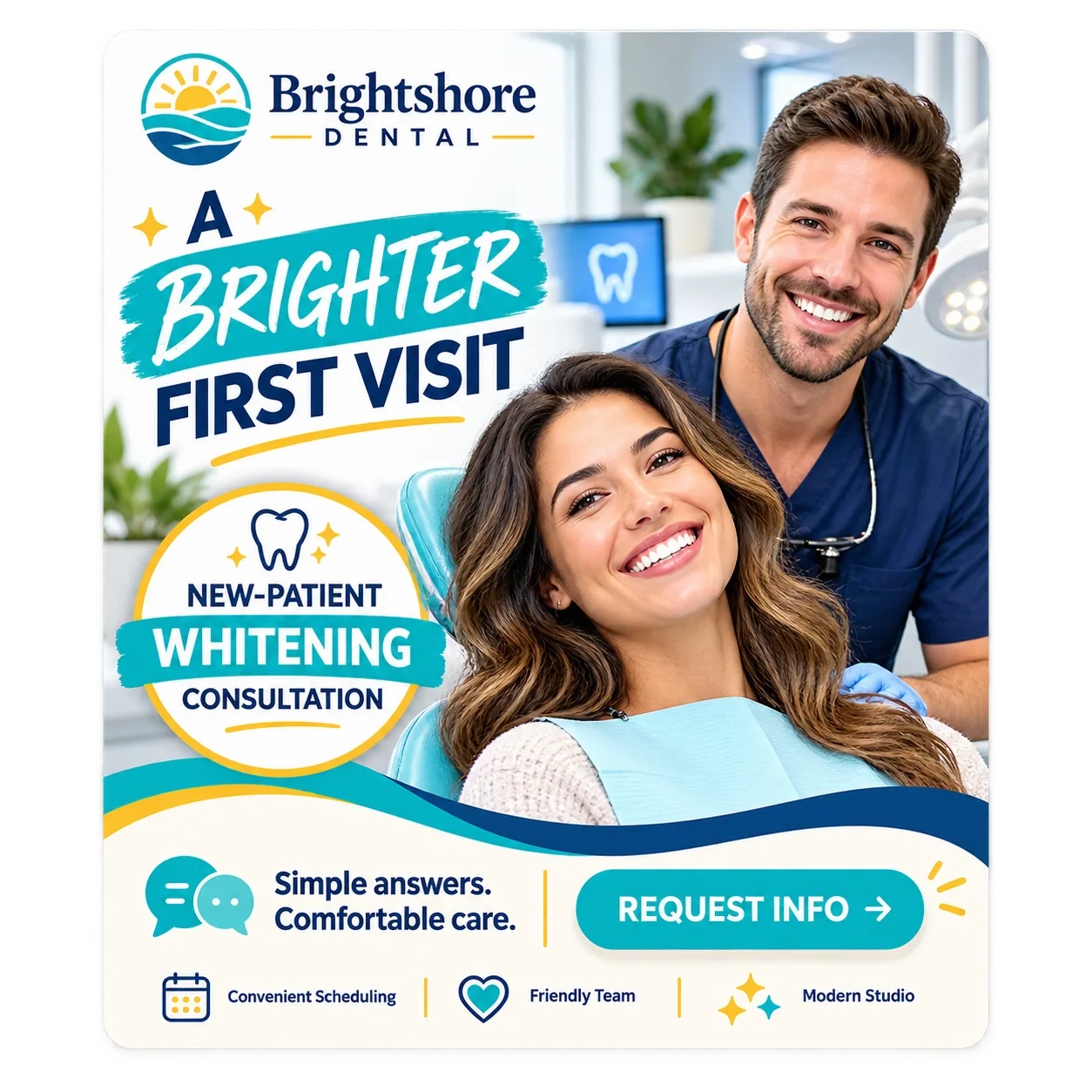
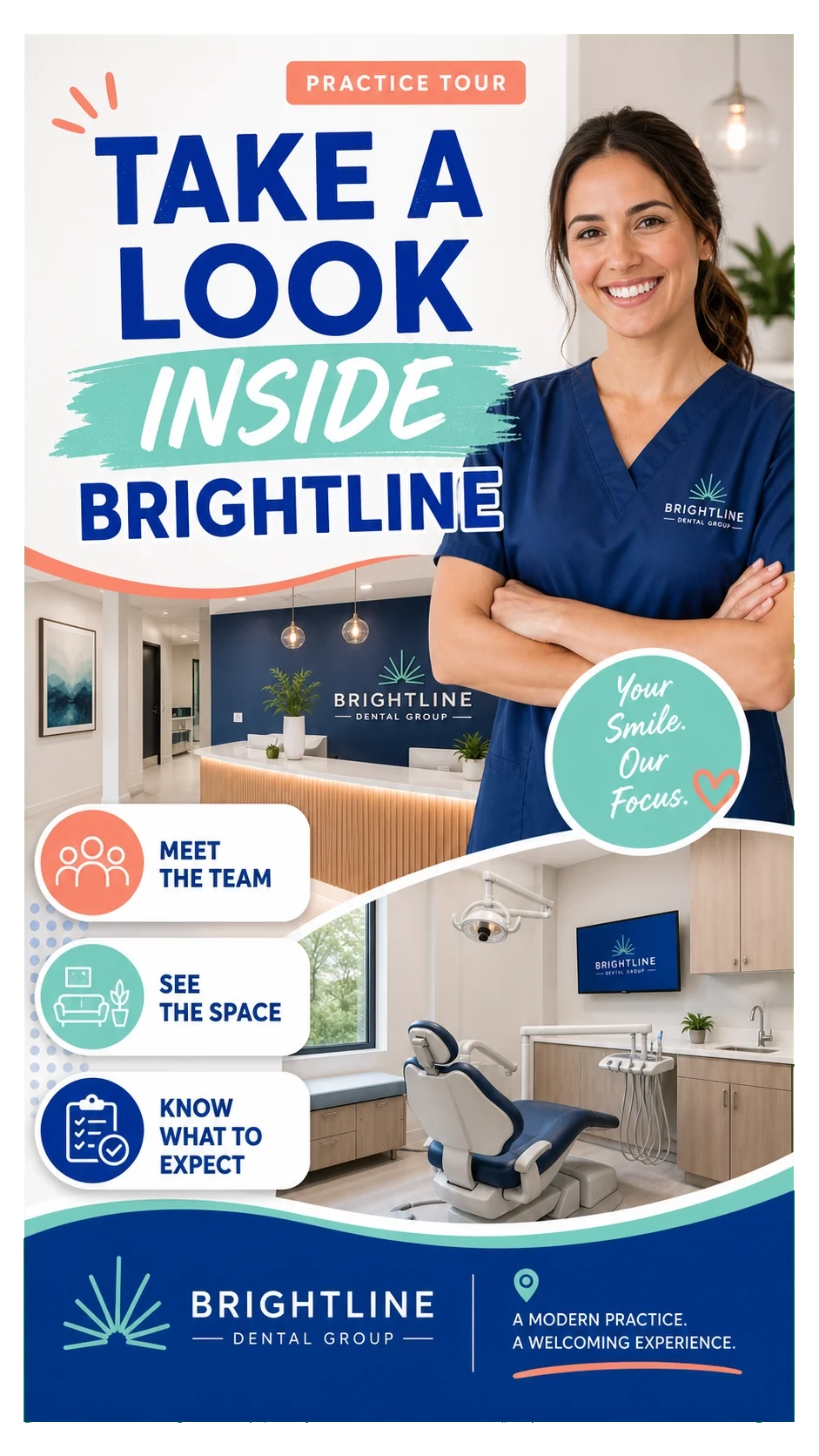
One offer, stated simply. Facebook special-offer and lead campaigns can promote a singular new-patient, whitening, or clear-aligner offer, and the guidance is to review privacy, platform and professional rules before launch. Meta's own standards say advertisers are responsible for understanding and complying with all applicable laws and regulations, which is where that review starts.
The documented campaigns. Facebook special-offer and lead campaigns can promote a singular new-patient, whitening, or clear-aligner offer; the guidance is to review privacy, platform, and professional rules before launch.
Meta's advertising standards state that advertisers are responsible for understanding and complying with all applicable laws and regulations, and that ads must not promote products, services, schemes or offers using identified deceptive or misleading practices, including those meant to scam people out of money or personal information.
Meta advertising standards
FTC advertising guidance for small business states that under the law advertising must be truthful and non-deceptive, that advertisers must have evidence to back up their claims, and that an ad is deceptive if it contains a statement — or omits information — that is likely to mislead consumers acting reasonably under the circumstances and is material, that is, important to a consumer's decision to buy or use the product; qualifying information necessary to prevent an ad from being deceptive should be presented clearly and conspicuously.
Federal Trade Commission, advertising guidance for small business
direct mail and digital marketing digital advertising services
Meta ad · Facebook
Reel · Instagram
One offer, reviewed
SMS
How does dental patient reactivation reach a lapsed patient?
The short answer
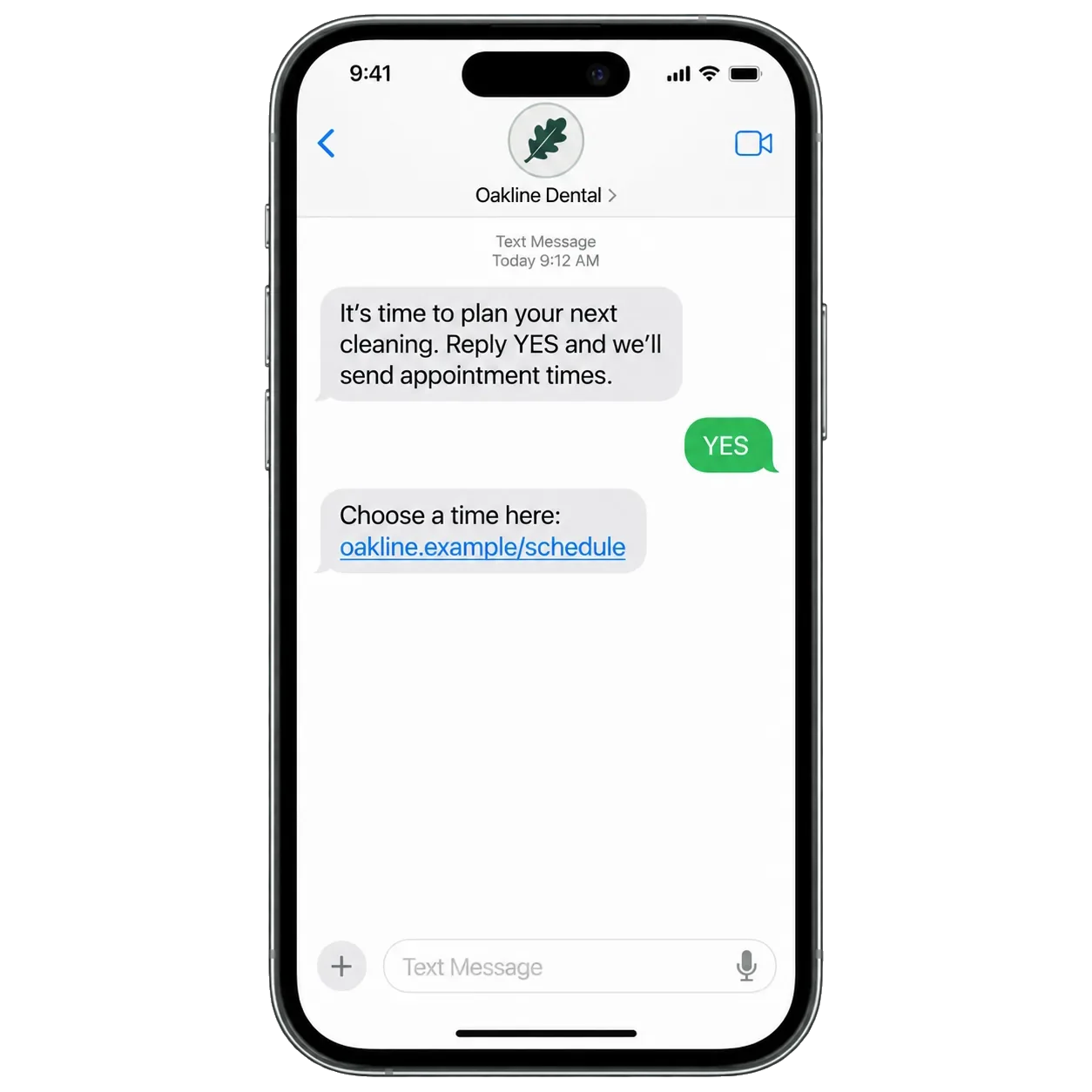
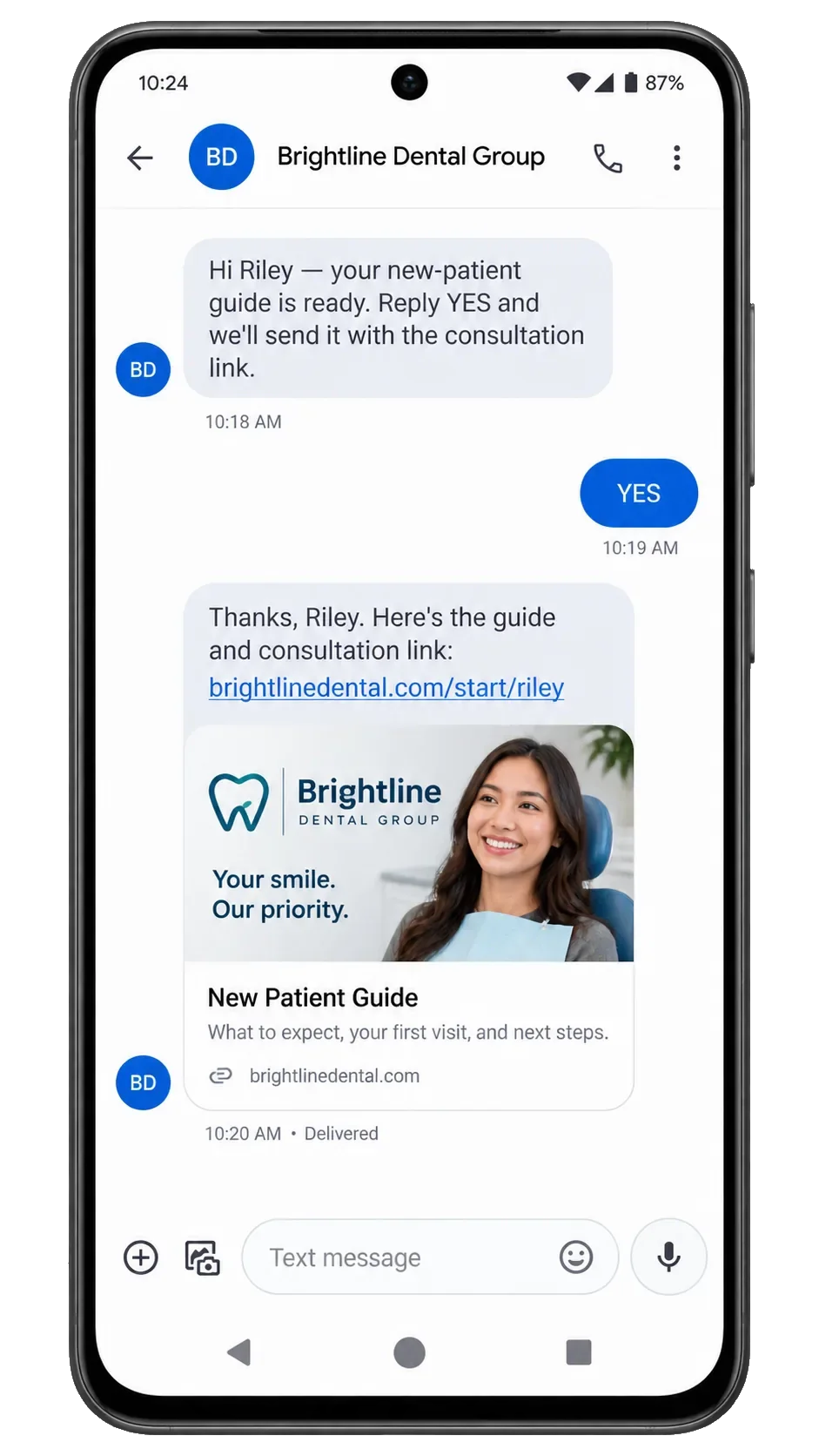
Through consented outreach, never a rented list. Consented SMS sequences support appointment reminders, hygiene recall, treatment follow-up and lapsed-patient reactivation, and lapsed patients are reactivated only through privacy-reviewed, consented outreach. CTIA's messaging principles say messages should be sent only after the consumer has opted in to receive them.
The documented texts. Consented SMS sequences support appointment reminders, hygiene recall, treatment follow-up, and lapsed-patient reactivation, and lapsed patients are reactivated only through privacy-reviewed, consented outreach.
CTIA's Messaging Principles and Best Practices state that message senders should support opt-in mechanisms and that messages should be sent only after the consumer has opted-in to receive them, and list entering a telephone number through a website, clicking a button on a mobile webpage, sending a message containing an advertising keyword, initiating the text message exchange, signing up at a point-of-sale or other on-site location, and opting-in over the phone using IVR among the mechanisms by which a consumer might demonstrate opt-in consent; that message senders should not use opt-in lists that have been rented, sold, or shared and should create and vet their own; and that senders should ensure consumers can opt out at any time, support multiple opt-out mechanisms, and acknowledge and honor all opt-out requests by sending one final opt-out confirmation message per campaign.
CTIA Messaging Principles and Best Practices, May 2023, §§5.1.2–5.1.4
SMS
SMS
Printing
Which dental marketing materials does a practice keep at the front desk?
The short answer
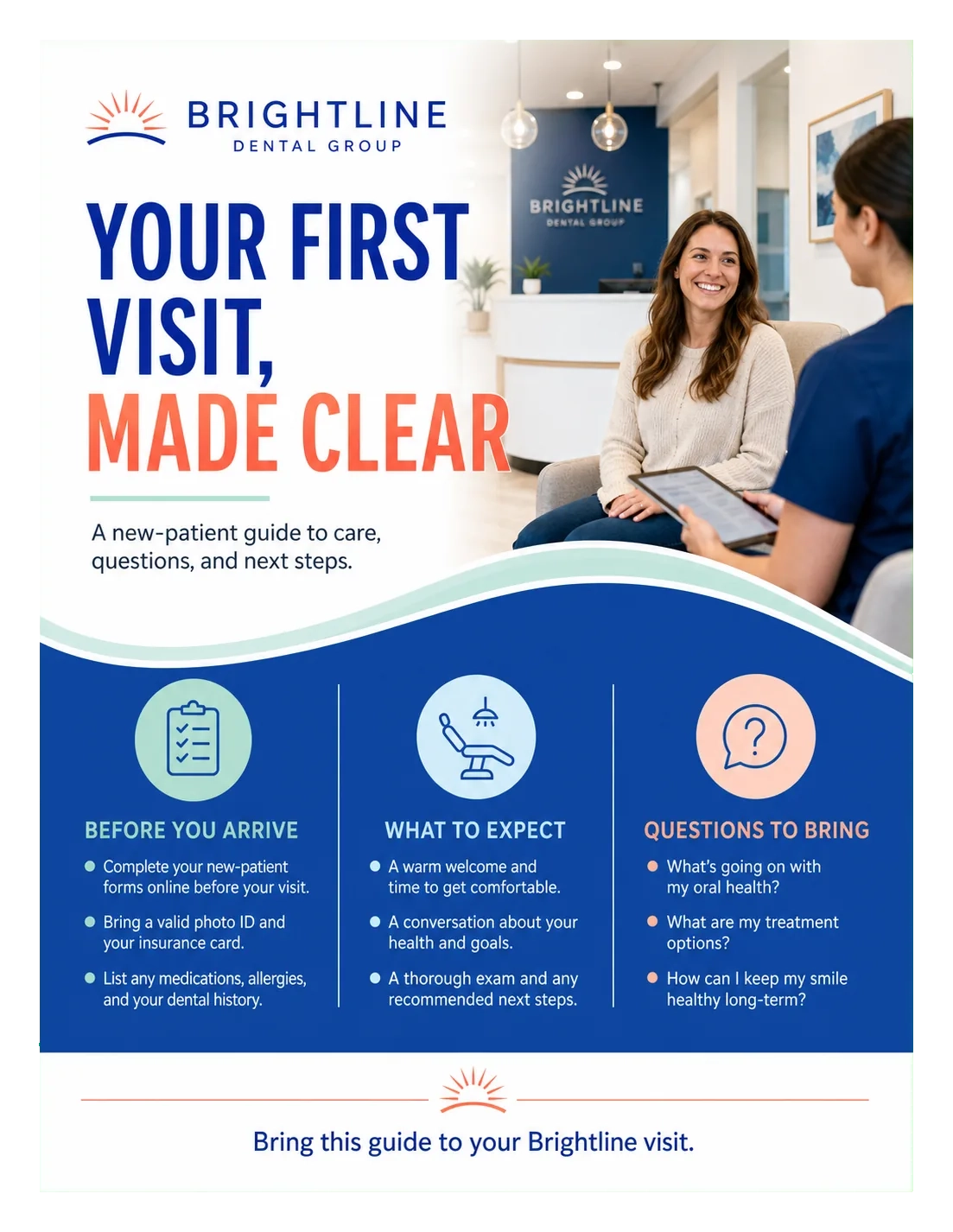
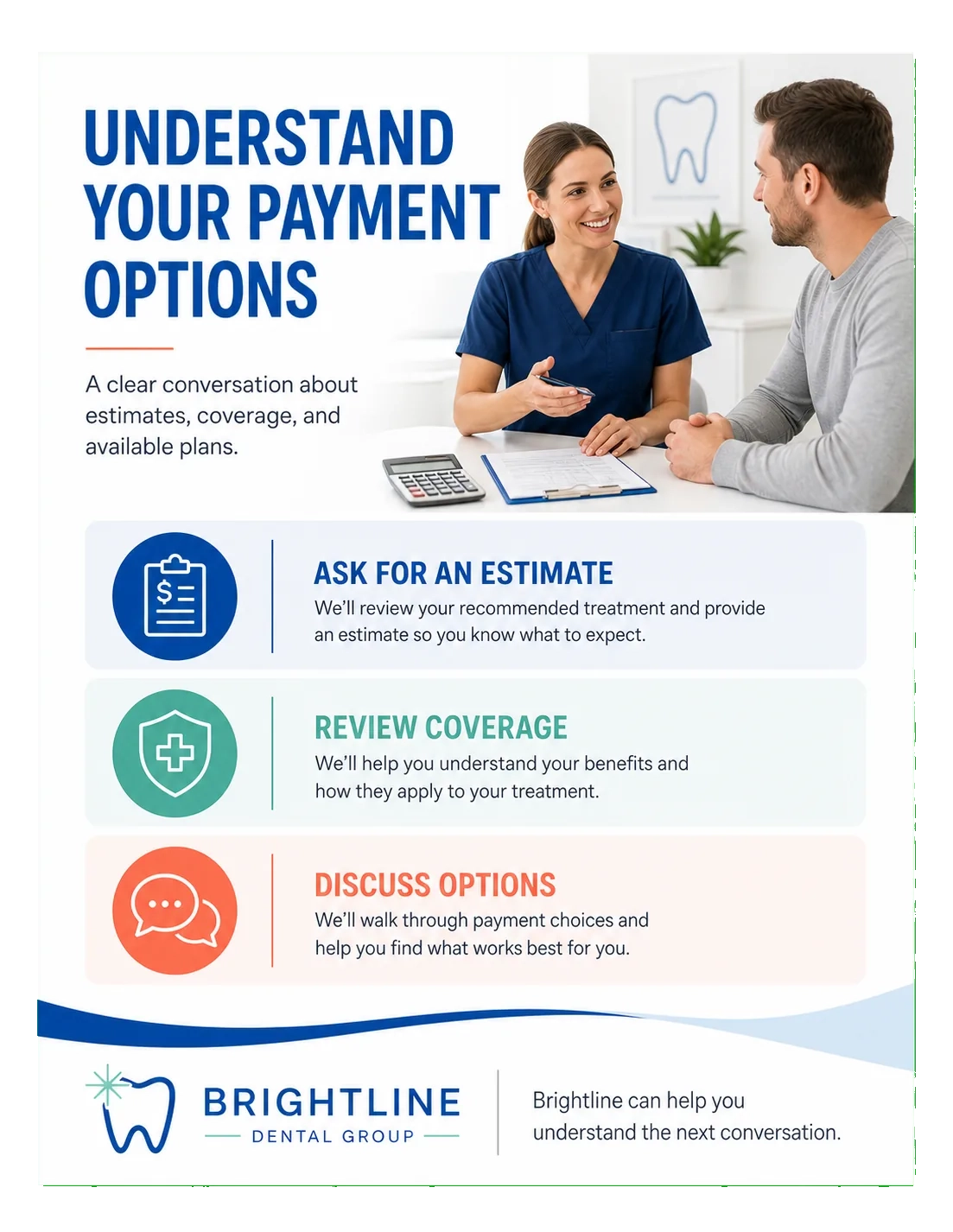
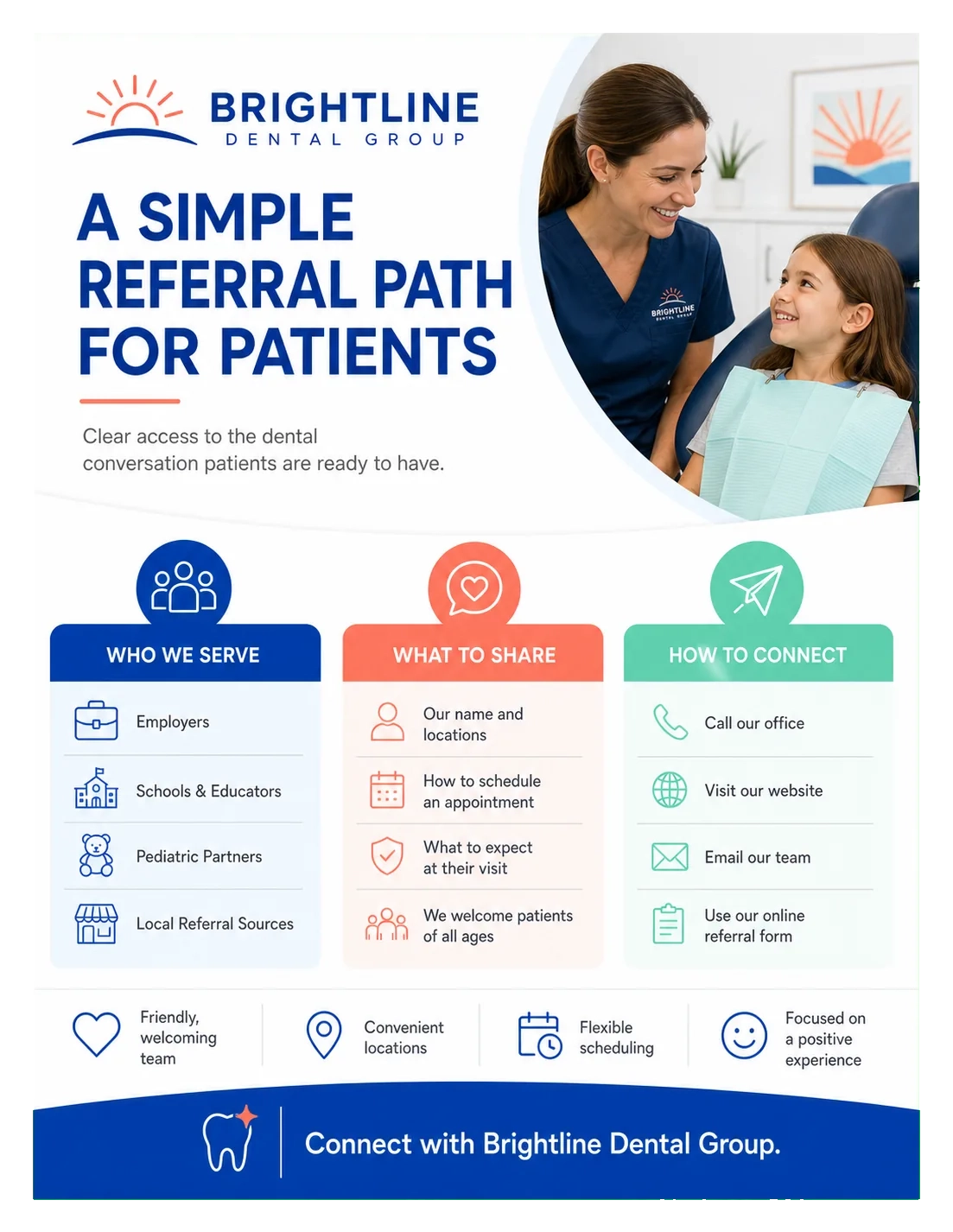
The standing set: postcards, practice and procedure brochures, referral pads, presentation folders, business cards, and letterhead and envelopes. Employer, school and referral-partner outreach is used to feed family and preventive-care demand, and the referral pads sit in that same set. Printing at MBI is commercial and variable-data printing, in house, so the mailed card and the desk set match.
The print set. The dental print set is postcards, practice and procedure brochures, referral pads, presentation folders, business cards, and letterhead and envelopes.
Referral partners. Employer, school and referral-partner outreach is used to feed family and preventive-care demand.
In house. Printing at MBI is commercial and variable-data printing produced in house.
The standing set
Guide · Printing
Explainer · Printing
One-sheet · Printing
Card · Printing
One program
Which four channels does a dental practice run together?
The short answer
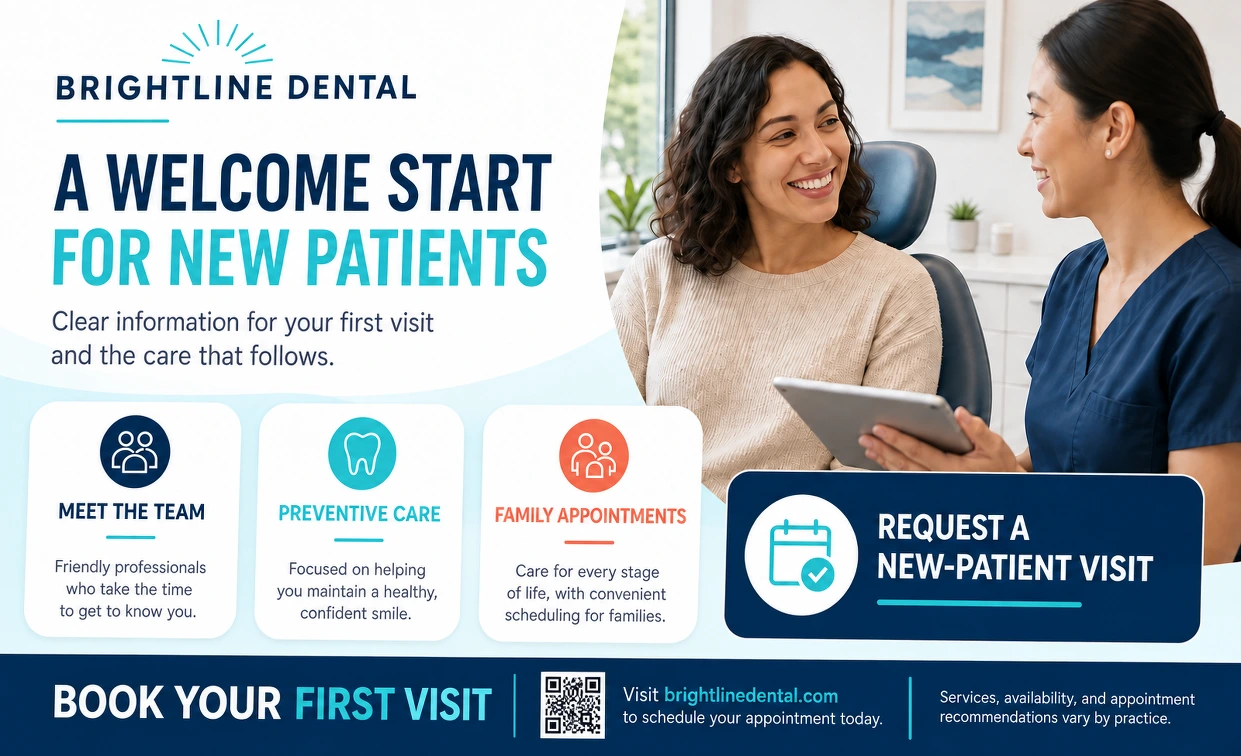
Four: new-mover and neighborhood direct mail carrying a new-patient exam or cleaning offer; a Facebook lead campaign built on one simple service offer; an SMS hygiene recall, treatment follow-up and lapsed-patient reactivation sequence; and the practice's own printed set. One team plans, produces and delivers all four.
One destination. The three researched dental campaigns run to one destination: a new-mover or neighborhood direct-mail campaign with a new-patient exam or cleaning offer; a Facebook lead campaign centered on one simple service offer, such as a new-patient special, whitening, or clear-aligner consultation; and an SMS hygiene recall, treatment follow-up, and lapsed-patient reactivation sequence.
The limits. Campaigns for this vertical follow ADA, state, FTC, HIPAA, and financing rules; substantiate claims and disclose material terms. PHI, patient photos, or testimonials are not used without appropriate authorization, and service-line consultation funnels for implants, cosmetic, family or urgent care are built without outcome promises.
One company. MBI is one company that plans, produces, and delivers from a single team in DeLand, Florida; data, print, and delivery have been in-house since 1989.
USPS Domestic Mail Manual 602.5.1 provides that each address, except for mail bearing an alternative address format, in a mailing at commercial First-Class Mail presorted or automation prices or USPS Marketing Mail prices is subject to the Move Update standard, and that each address and associated addressee used on the mailpieces in a mailing must be updated within 95 days before the mailing date with one of the USPS-approved methods in 5.2, which include Address Change Service (ACS) and the National Change of Address Linkage System (NCOALink).
USPS Domestic Mail Manual 602.5.1
direct mail marketing services digital advertising services printing services
Mailer · Direct Mail
Four channels, one program
Questions
Questions a dental practice asks before it mails
Searched for dentist marketing, marketing for dentists or dental practice marketing? Same work, same answers.
Which campaigns make up a dental program at MBI?
Three, run together: a new-mover or neighborhood direct-mail campaign with a new-patient exam or cleaning offer; a Facebook lead campaign centered on one simple service offer, such as a new-patient special, whitening, or a clear-aligner consultation; and an SMS hygiene recall, treatment follow-up and lapsed-patient reactivation sequence.
What goes on the new-mover postcard a dental practice sends?
A clear new-patient offer and a direct booking call to action. Dental direct mail commonly targets new residents and nearby households with exactly that, and postcards and brochures are the pieces used for it. MBI selects the households, designs and prints the piece, and mails it.
What is included in a quote for a dental drop?
A dental drop has no list price: it is quoted in two halves, printing the postcard or brochure and mailing it. Seven decisions move both: quantity; format and finished size; paper and weight; color, coating and finishing; data and personalization; postage, mail class and sortation; and entry and drop strategy. /capabilities/direct-mail/direct-mail-cost walks a dental practice through them.
Who may receive a dental recall or reactivation text?
Only a patient who has opted in. CTIA's messaging principles say senders should support opt-in mechanisms and that messages should be sent only after the consumer has opted in, list entering a number on a website or signing up on site among the ways consent is shown, and say senders should not use rented, sold or shared lists.
What must be authorized before patient information reaches a dental campaign?
45 CFR 164.508(a)(3) provides that a covered entity must obtain an authorization for any use or disclosure of protected health information for marketing, except for a face-to-face communication made to an individual or a promotional gift of nominal value; where the marketing involves financial remuneration from a third party, the authorization must say so.
What keeps a dental ad inside the rules before it runs?
Review, before launch. Campaigns follow ADA, state, FTC, HIPAA and financing rules, substantiate claims and disclose material terms. Patient information, patient photos and testimonials stay out without appropriate authorization, and consultation funnels for implants, cosmetic, family or urgent care are built without outcome promises.
Get started
Start a dental campaign.
Say which practice or group it runs for and the new-patient offer it carries. It goes to a real member of the MBI team, not a queue.