
Healthcare & Wellness / Medical & Specialty Care
Medical practice marketing , from the household list to the appointment reminder
Medical practice marketing at MBI is three campaigns run as one: a geo-targeted new-patient postcard promoting a low-friction introductory appointment, specialty access or same-week availability; a privacy- and policy-reviewed local Facebook and Instagram inquiry campaign; and a consent-based texting workflow for appointment reminders, missed-visit recovery and reactivation.
Not sure where to start? Talk with our teamMedical practice marketing
What does a multi-site medical group need from a marketing partner?
The short answer
Multi-site medical groups, specialty networks, ambulatory providers and health systems run appointment access and service-line marketing under governance. What that needs is a partner who works inside it: one team that selects the households, designs and prints the piece, mails it, runs the local social campaign and sends the consented reminders, answering for all four.
Built for. The buyer for this vertical is multi-site medical groups, specialty networks, ambulatory providers, and health systems with appointment access and service-line marketing governance.
The review. This vertical's research records that campaigns require service-line, HIPAA, clinical, and legal review, that they should avoid individualized health targeting and unsupported outcomes, and that PHI must not be used for advertising without the appropriate authorization and vendor safeguards.
One team. MBI is one company that plans, produces, and delivers from a single team in DeLand, Florida, and data, print, and delivery have been in-house since 1989.
nationwide direct mail direct mail marketing services digital advertising services printing services
The review
Direct mail
What does a medical practice direct mail postcard offer a household?
The short answer
Medical practice direct mail is a geo-targeted postcard into the households around a practice. It targets appropriate household demographics, carrying a new-patient appointment offer with a clear call or booking CTA. At commercial card prices a postcard must be no more than 6 inches high, no more than 9 inches long and no thicker than 0.016 inch.
The documented mail. Medical-practice postcards commonly target appropriate household demographics with a new-patient appointment offer and clear call or booking CTA.
USPS Domestic Mail Manual 602.5 provides that each address, except for mail bearing an alternative address format, in a mailing at commercial First-Class Mail presorted or automation prices or USPS Marketing Mail prices is subject to the Move Update standard, and that each address and associated addressee used on the mailpieces in a mailing must be updated within 95 days before the mailing date with one of the USPS-approved methods, which include Address Change Service and the National Change of Address Linkage System (NCOALink).
USPS Domestic Mail Manual 602.5
postcard mailing services direct mail mailing lists targeted direct mail
Postcard · Direct Mail

Around the practice
Facebook and Instagram
What may medical practice Facebook ads carry, and what stays out?
The short answer
Local inquiry ads, short staff or facility videos, service carousels and Messenger support: a medical-practice social campaign can use all four, subject to privacy, platform and professional review. Personal-health targeting and protected health information stay out of it. MBI produces the creative, sets the local audience and runs the campaign inside those limits.
The documented campaigns. Medical-practice social campaigns can use local inquiry ads, short staff or facility videos, service carousels, and Messenger support, subject to privacy, platform, and professional review, and avoid personal-health targeting and protected health information.
Meta's advertising standards state that ads must not contain content that asserts or implies personal attributes, including physical or mental health (including medical conditions), and that advertisers are responsible for understanding and complying with all applicable laws and regulations.
Meta advertising standards, personal attributes
digital advertising services direct mail and digital marketing
Meta ad · Facebook

Reel · Instagram

SMS
When may a practice send patient text message reminders, and what can they say?
The short answer
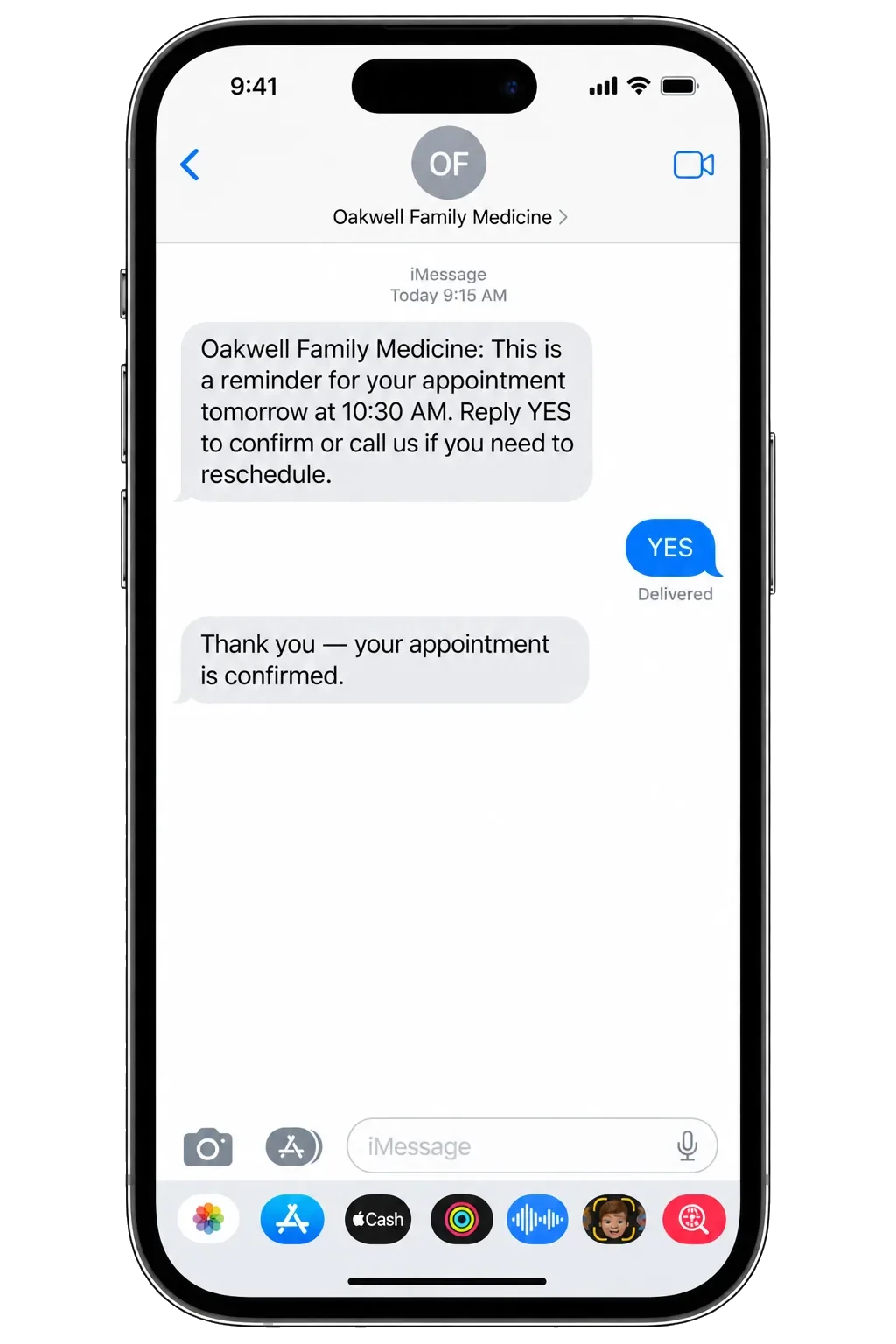
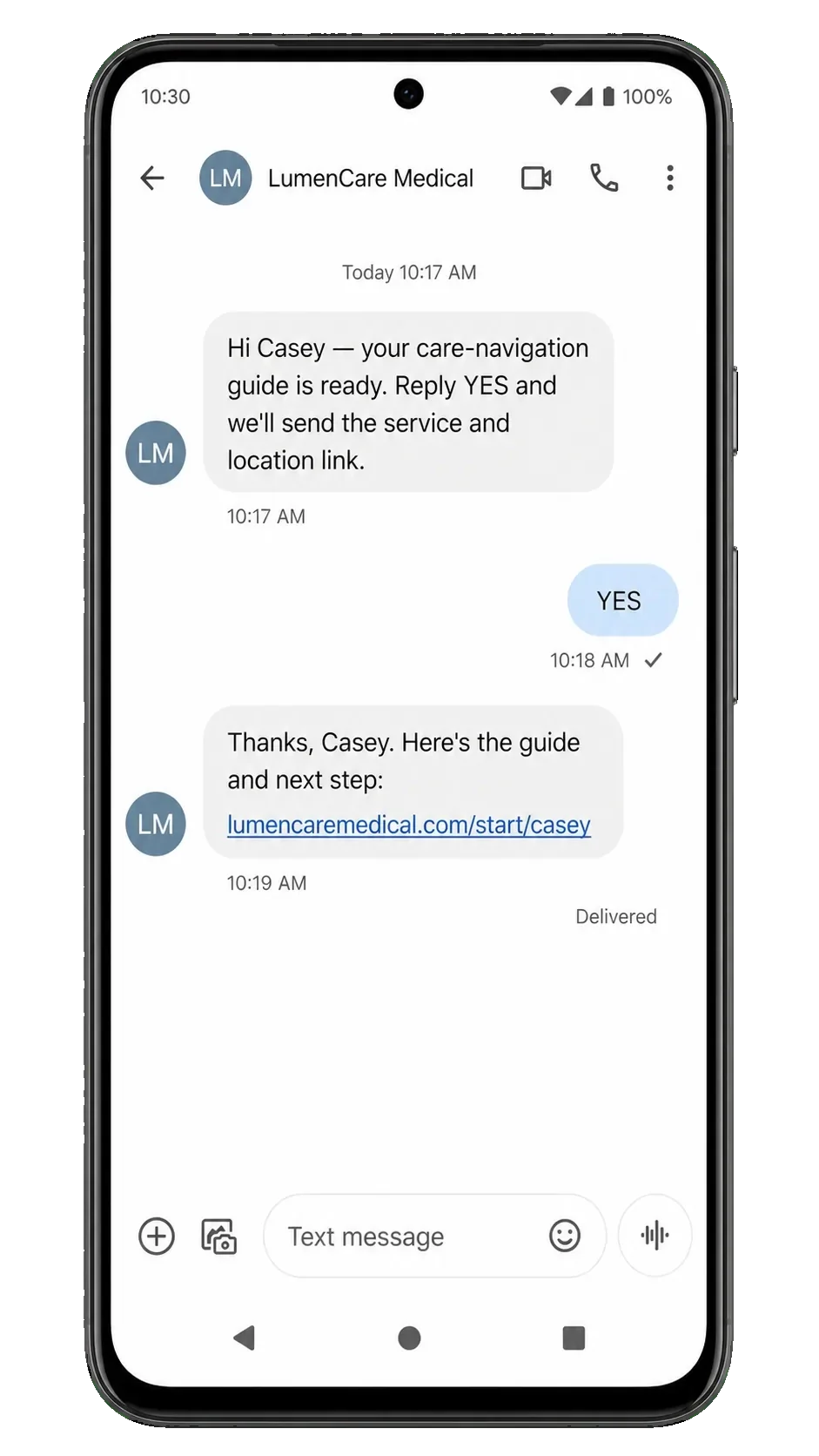
After the patient has opted in. CTIA's messaging principles say messages should be sent only after the consumer has opted in and that senders should not use rented, sold or shared opt-in lists. Privacy-aware, consented texting then carries confirmations, day-before and day-of reminders, reschedule links, missed-appointment recovery and reactivation.
The documented texts. Privacy-aware, consented texting is used for confirmations, day-before and day-of reminders, reschedule links, missed-appointment recovery, and reactivation.
CTIA's Messaging Principles and Best Practices state that message senders should support opt-in mechanisms and that messages should be sent only after the consumer has opted in to receive them, and list entering a telephone number through a website, clicking a button on a mobile webpage, sending a message containing an advertising keyword, initiating the exchange, signing up at a point-of-sale or other on-site location, and opting in over the phone by IVR among the mechanisms by which a consumer might demonstrate opt-in consent; senders should also document opt-in consent, retaining the timestamp of consent acquisition and the medium by which it was acquired among the records kept.
CTIA Messaging Principles and Best Practices, May 2023, §5.1.2
45 CFR 164.508(a)(3) provides that a covered entity must obtain an authorization for any use or disclosure of protected health information for marketing, except if the communication is a face-to-face communication made by a covered entity to an individual or a promotional gift of nominal value provided by the covered entity, and that where the marketing involves financial remuneration to the covered entity from a third party the authorization must state that such remuneration is involved. Appointment reminders are treatment communications rather than marketing under 45 CFR 164.501, so the question is the patient's recorded opt-in and minimum-necessary content, not an authorization.
45 CFR 164.508(a)(3), the HIPAA privacy rule
SMS
SMS
Opt-in first
Service line marketing
How does medical group service line marketing introduce a new location or provider?
The short answer
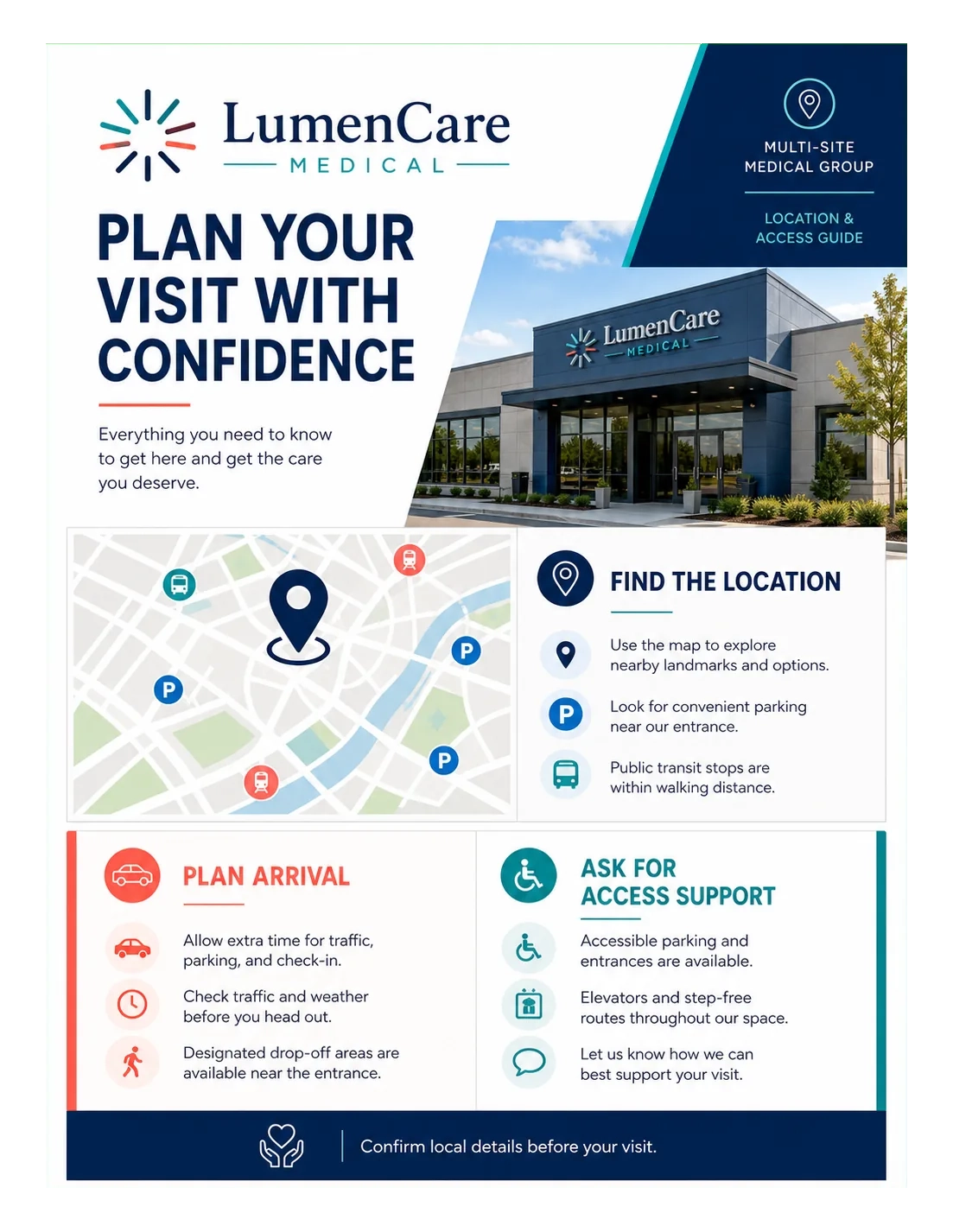
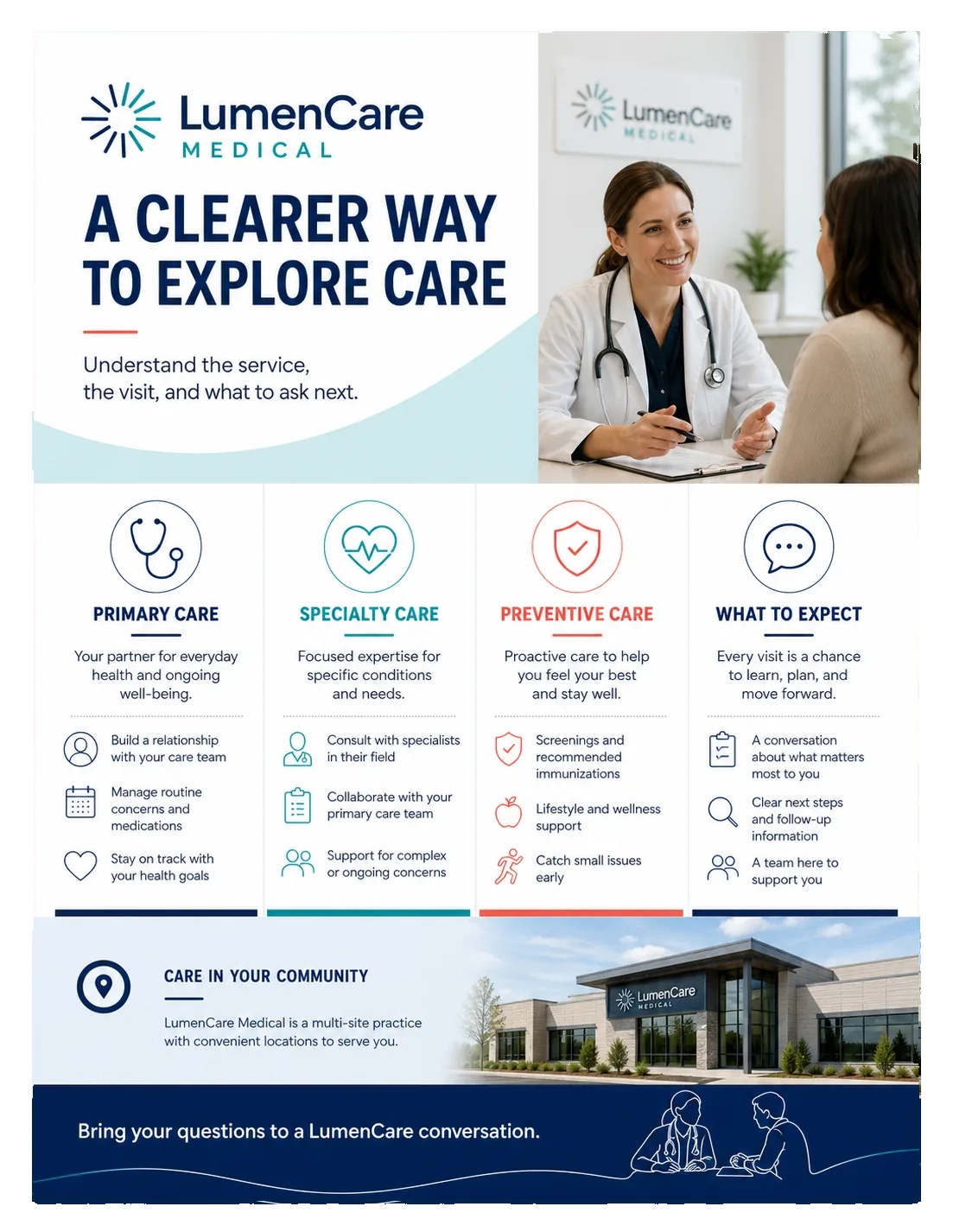
Through credentialed, access-focused content. A new location, a new provider or a new service line is promoted with printed material carrying those credentials and that access, and the households around the site can be mailed the same introduction. One team designs it, prints it and mails it, so every site in a group reads alike.
The documented campaigns. The campaigns this vertical's §9 names are: promoting new locations, providers and service lines through credentialed, access-focused content; building screening, wellness and care-navigation campaigns that direct to an appropriate appointment path; using physician/referral and community education campaigns for priority service lines; and retargeting general service-interest traffic with what-to-expect content and availability-aware intake.
Card · Printing

Guide · Printing
Explainer · Printing
Printing
Which printed pieces does a medical practice keep on hand?
The short answer
Postcards, flyers, appointment reminder cards, health-fair handouts, seasonal promotion materials and door hangers: six formats, and commercial and variable-data printing sit on MBI's own floor. The reminder card handed across the front desk and the postcard that arrives at home come from one team, in-house since 1989, and read as one practice.
The formats. The printed formats this vertical's research names are postcards, flyers, appointment reminder cards, health-fair handouts, seasonal promotion materials and door hangers.
USPS Domestic Mail Manual 201.1.2.1 sets card-price physical standards at not less than 3-1/2 inches high, 5 inches long and 0.007 inch thick, with a card more than 4-1/4 inches high or 6 inches long required to be at least 0.009 inch thick; at not more than 4-1/4 inches high, 6 inches long or 0.016 inch thick for each stamped card or each half of a double-stamped card or double postcard; and at not more than 6 inches high, 9 inches long or 0.016 inch thick for each postcard; within an aspect ratio (length divided by height) of 1.3 to 2.5 inclusive.
USPS Domestic Mail Manual 201.1.2.1
In house. Printing at MBI is commercial and variable-data printing produced in house.
One-sheet · Printing
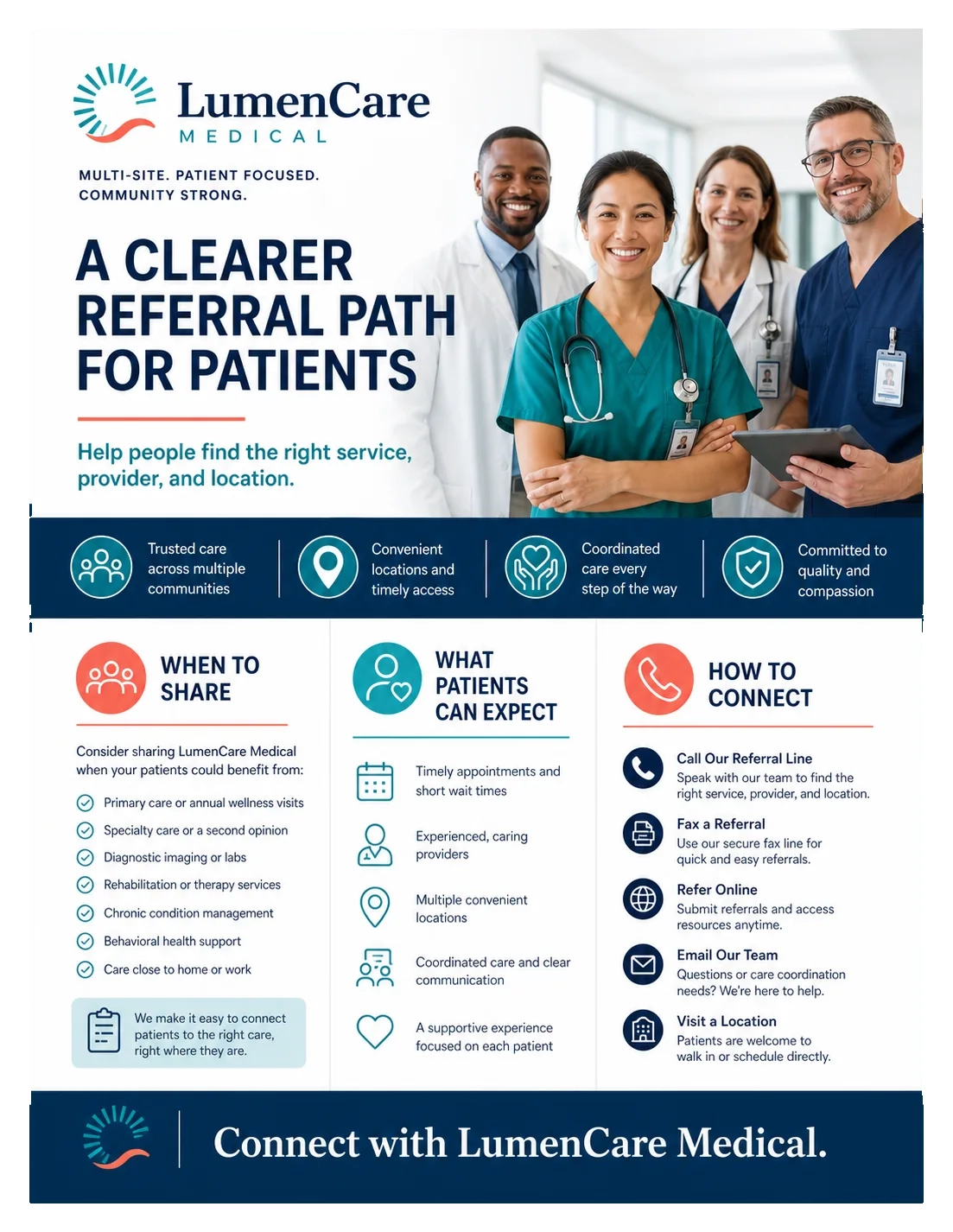
Kit · Printing
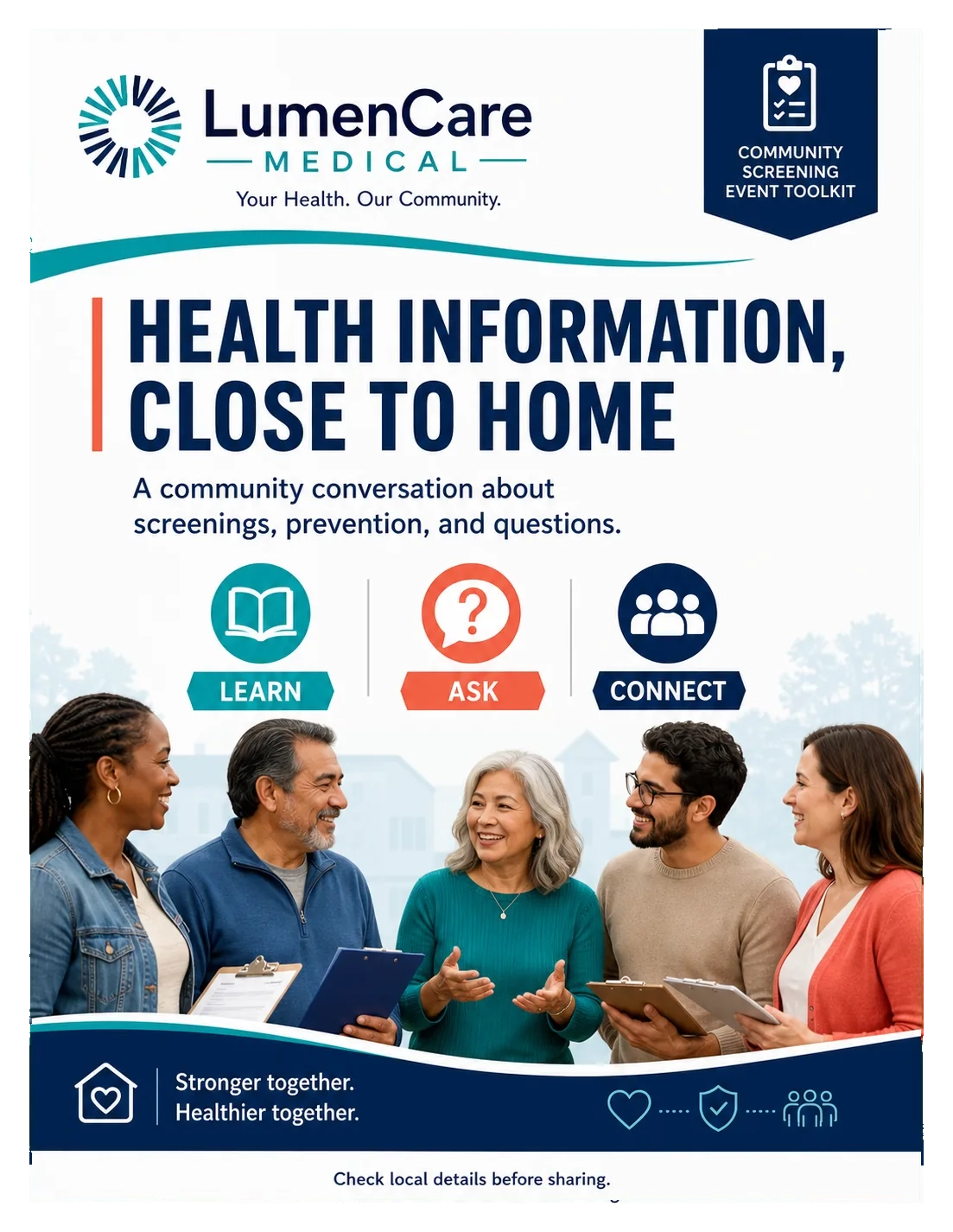
One floor, one practice
Questions
Questions a medical practice asks before it mails
Searched for marketing for medical practices, medical practice marketing agency or physician practice marketing? Same work, same answers.
Which campaigns does MBI run for a medical practice?
Three. A geo-targeted new-patient postcard campaign promoting a low-friction introductory appointment, specialty access, or same-week availability. A privacy- and policy-reviewed local Facebook and Instagram inquiry campaign using a booking form, staff or facility video, or a service carousel. And a consent-based SMS appointment reminder, missed-visit recovery and reactivation workflow.
Who receives a new-patient postcard from a medical practice?
Households around the practice, selected on appropriate demographics rather than on anything about a person's health. Medical-practice postcards commonly target appropriate household demographics with a new-patient appointment offer and a clear call or booking CTA. MBI builds the selection, designs the card, prints it and mails it.
What moves the number on a medical practice mail quote?
No list price exists for a medical practice mailing. A quote resolves to two costs, producing the piece and mailing it, and seven decisions move them: quantity, format and finished size, paper and weight, color, coating and finishing, data and personalization, postage, mail class and sortation, and entry and drop strategy. /capabilities/direct-mail/direct-mail-cost sets them out.
Why does a medical practice ad avoid naming a condition?
Meta's advertising standards say ads must not contain content that asserts or implies personal attributes, and list physical or mental health, including medical conditions, among those attributes. A medical-practice social campaign also avoids personal-health targeting and protected health information, so the ad names the service and the practice, never the patient.
Which patient information may a medical practice put into a campaign?
45 CFR 164.508(a)(3) provides that a covered entity must obtain an authorization for any use or disclosure of protected health information for marketing, except for a face-to-face communication made by a covered entity to an individual or a promotional gift of nominal value provided by the covered entity. MBI builds campaigns that leave protected health information out.
What has to happen before an appointment reminder text goes out?
The patient opts in. CTIA's messaging principles say senders should support opt-in mechanisms and that messages should be sent only after the consumer has opted in, that senders should not use rented, sold or shared opt-in lists, and that consumers should be able to opt out at any time through multiple mechanisms.
What happens to an address when a patient moves before the drop?
It is updated before the mail date. USPS requires each address in a mailing at commercial First-Class Mail presorted or automation prices, or USPS Marketing Mail prices, to be updated within 95 days before the mailing date with a USPS-approved method such as Address Change Service or NCOALink.
Get started
Start a medical practice campaign.
Say which of the three campaigns it is, and the site or sites it runs for. It goes to a real member of the MBI team, not a queue.